אנו משתמשים ב-Cookies כדי לשפר את החוויה שלך. כדי לקיים ההנחיה החדשה של e-Privacy, עלינו לבקש את הסכמתך להגדיר את ה-Cookies. קבלת מידע נוסף.

690.00 ₪
IoT Security: Advances in Authentication
690.00 ₪
ISBN13
9781119527923
יצא לאור ב
Hoboken
זמן אספקה
21 ימי עסקים - לא במלאי בארץ
עמודים / Pages
320
פורמט
Hardback
תאריך יציאה לאור
20 בדצמ׳ 2019
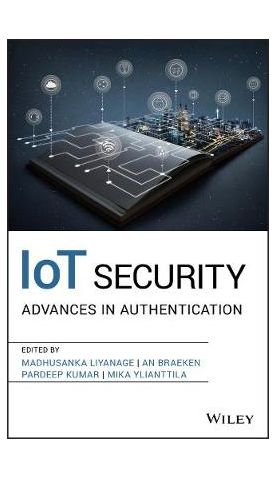

An up-to-date guide to an overview of authentication in the Internet of Things (IoT)
The Internet of things (IoT) is the network of the countless physical devices that have the possibility to connect and exchange data. Among the various security requirements, authentication to the IoT is the first step to prevent the impact of attackers. IoT Security offers an important guide into the development of the many authentication mechanisms that provide IoT authentication at various levels such as user level, device level and network level.
The book covers a wide range of topics including an overview of IoT and addresses in detail the security challenges at every layer by considering both the technologies and the architecture used. The authors-noted experts on the topic-provide solutions for remediation of compromised security, as well as methods for risk mitigation, and offer suggestions for prevention and improvement. In addition, IoT Security offers a variety of illustrative use cases. This important book:
Offers an authoritative reference designed for use by all IoT stakeholders
Includes information for securing devices at the user, device, and network levels
Contains a classification of existing vulnerabilities
Written by an international group of experts on the topic
Provides a guide to the most current information available on IoT security
Written for network operators, cloud operators, IoT device manufacturers, IoT device users, wireless users, IoT standardization organizations, and security solution developers, IoT Security is an essential guide that contains information on security features, including underlying networks, architectures, and security requirements.
| עמודים / Pages | 320 |
|---|---|
| פורמט | Hardback |
| ISBN10 | 1119527929 |
| יצא לאור ב | Hoboken |
| תאריך יציאה לאור | 20 בדצמ׳ 2019 |
| תוכן עניינים | Preface Acknowledgments Part I : IoT Overview Chapter 1: Introduction to IoT 1. Introduction 1.1. Evolution of IoT 2. IoT Architecture and Taxonomy 3. Standardization E?orts 4. IoT Applications 4.1. Smart Home 4.2. Smart City 4.3. Smart Energy 4.4. Healthcare 4.5. IoT Automotive 4.6. Gaming, AR and VR 4.7. Retail 4.8. Wearable 4.9. Smart Agriculture 4.10. Industrial Interne 4.11. Tactile Internet 5. Conclusion Chapter 2: Introduction to IoT Security 1. Introduction 2. Attacks and Countrameasures 2.1. Perception Layer 2.2. Network Layer 2.3. Application Layer 3. Authentication and Authorization 3.1. Authentication 3.2. Authorization 3.3. Authentication at IoT Layers 4. Other Security Features and Related Issues 4.1. The Simplified Layer Structure 4.2. The Idea of Middleware 4.3. Cross-Layer Security Problem 4.4. Privacy 4.5. Risk Mitigation 5. Discussion Part II : IoT Network and Communication Authentication Chapter 3: Symmetric Key Based Authentication with an Application to Wireless Sensor Networks 1. Introduction 2. Related Work 3. System Model and Assumptions 3.1. Design goals 3.2. Setting 3.3. Notations 3.4. Attack model 4. Scheme in normal mode 4.1. Installation phase 4.2. Group node key 4.3. Individual cluster key 4.4. Pairwise key derivation 4.5. Multicast key 4.6. Group cluster key 5. Authentication 6. Scheme in change mode 6.1. Capture of CN 6.2. Capture of CH 6.3. Changes for honest nodes 7. Security analysis 7.1. Resistance against impersonation attack 7.2. Resistance against node capture 7.3. Resistance against replay attacks 8. E?ciency 8.1. Number of communication phases 8.2. Storage requirements 8.3. Packet fragmentation 9. Conclusions Chapter 4: Public Key Based Protocols - EC Crypto 1. Introduction to ECC 1.1. Notations 1.2. ECC for authentication and key management 2. ECC based Implicit Certi?cates 2.1. Authentication and key management using ECC implicit certi?cates 3. ECC based signcryption 3.1. Security features 3.2. Scheme 4. ECC based group communication 4.1. Background and assumptions 4.2. Scheme 5. Implementation aspects 6. Discussion Chapter 5: Lattice-Based Cryptography and Internet of Things 1. Introduction 1.1. Organization 2. Lattice-Based Cryptography 2.1. Notations 2.2. Preliminaries 2.3. Computational Problems 2.4. State-of-the-Art 3. Lattice-Based Primitives 3.1. One-way and collision-resistant hash functions 3.2. Passively secure encryption 3.3. Actively secure encryption 3.4. Trapdoor functions 3.5. Gadget trapdoor 3.6. Digital signatures without trapdoors 3.7. Pseudorandom functions (PRF) 3.8. Homomorphic Encryption 3.9. Identity-Based Encryption (IBE) 3.10. Attribute-Based Encryption 4. Lattice-Based Cryptography for IoT 5. Conclusion Part III: IoT User Level Authentication Chapter 6: Efficient and Anonymous Mutual Authentication Protocol in Multi-Access Edge Computing (MEC) Environments 1. Introduction 2. Related work 3. Network model and adversary model 4. Proposed Scheme 4.1. System setup for the edge nodes registration at the registration center 4.2. User registration phase 4.3. Login and user authentication phase 4.4. Password update phase 5. Security and Performance evaluation 5.1. Informal security analysis 5.2. Performance analysis 6. Conclusion Chapter 7: Biometric-Based Robust Access Control Model for Industrial Internet of Things Applications 1. Introduction 2. Related work: 3. Network model, threat model and security requirements. 3.1. Network model: 3.2. Threat model: 3.3. Security goals: 4. Proposed Access Control Model in IIoT 4.1. System setup: 4.2. Authentication and key establishment: 5. Security and performance evaluations: 5.1. Informal security analysis: 5.2. Performance analysis: 6. Conclusions: Chapter 8: Gadget Free Authentication 1. Introduction to Gadget Free World 2. Introduction to Biometrics 3. Gadget Free Authentication 4. Preliminary aspects 4.1. Security Requirements 4.2. Setting 4.3. Notations 5. The system 5.1. Registration phase 5.2. Installation phase 5.3. Request phase 5.4. Answer phase 5.5. Update phase 6. Security analysis 6.1. Accountability 6.2. Replay attacks 6.3. Insider attacks 6.4. HW/SW attacks 6.5. Identity privacy 7. Performance Analysis 7.1. Timing for cryptographic/computational operation 7.2. Communication cost 8. Conclusions Chapter 9: WebMaDa 2.1 - A Web-Based Framework for Handling User Requests Automatically and Addressing Data Control in Parallel 1. IoT-related Concerns 2. Design Decisions 3. WebMaDa's History 4. WebMaDa 2.1 4.1. Email Notifications 4.2. Data Control Support 5. Implementation 5.1. Mailing Functionality 5.2. Logging Functionality 5.3. Filtering Functionality 6. Proof of Operability 6.1. Automated Request Handling 6.2. Filtering Functionality Using Logging Solution 7. Summary and Conclusions Part IV: IoT Device Level Authentication Chapter 10: PUF Based Authentication and Key Exchange for Internet of Things 1. Introduction 2. Related Work 2.1. Key Agreement from IoT Device to Server 2.2. Key Agreement between Two IoT Devices 3. Preliminaries 3.1. System Architecture 3.2. Assumptions 3.3. Attack model 3.4. Cryptographic Operations 4. Proposed system 4.1. Registration phase 4.2. Security Association phase 4.3. Authentication and Key Agreement Phase 5. Security Evaluation 6. Performance 6.1. Computational Cost 6.2. Communication Cost 7. Conclusions Chapter 11: Hardware Based Encryption via Generalized Synchronization of Complex Networks 1. Introduction 2. System scheme: Synchronization without correlation 2.1. The Delay-Filter-Permute block 2.2. Steady-state dynamics of the DFP 2.3. DFP bitstream generation 2.4. Sensitivity to changes in the permutation table 3. The chaotic followers 3.1. The Permute-Filter block 3.2. Brute force attack 3.3. PF bitstream generation 4. The complete system 4.1. Image encryption example 4.2. Usage for authentication 5. Conclusions and outlook Part V : IoT Use cases and Implementations Chapter 12: IoT Use Cases and Implementations: Healthcare 1. Introduction 2. Remote patient monitoring architecture 3. Security related to eHealth 3.1. IoT authentication 4. Remote patient monitoring security 4.1. Mobile Application Security 4.2. Communication Security 4.3. Data Integrity 4.4. Cloud Security 4.5. Audit Logs 4.6. Intrusion detection module 4.7. Authentication architecture 4.8. Attacks on remote patient monitoring platform 5. Conclusion Chapter 13: Secure and Efficient Privacy-Preserving Scheme in Connected Smart Grid Networks 1. Introduction 2. Preliminaries 2.1. System model 2.2. Security requirements 2.3. Cryptographic operations and notations 3. Proposed Scheme 3.1. Initialisation phase 3.2. Smart meter registration phase 3.3. Secure Communication between smart meter and aggregator 4. Security Analysis 4.1. Formal proof 4.2. Informal discussion 5. Performance Analysis 5.1. Computation costs 5.2. Communication costs 6. Conclusions Chapter 14: Blockchain-Based Cyber Physical Trust Systems 1. Introduction 2. Related work 3. Overview of use-cases and security goals 4. Proposed Approach 5. Evaluation results 5.1. Security features 5.2. Testbed results 6. Conclusion Index |
Login and Registration Form