אנו משתמשים ב-Cookies כדי לשפר את החוויה שלך. כדי לקיים ההנחיה החדשה של e-Privacy, עלינו לבקש את הסכמתך להגדיר את ה-Cookies. קבלת מידע נוסף.

262.00 ₪
The Armenians in the Medieval Islamic World: Medieval Cosmopolitanism and Images of Islamthirteenth
262.00 ₪
ISBN13
9781138515413
יצא לאור ב
London
זמן אספקה
21 ימי עסקים - לא במלאי בארץ
עמודים / Pages
316
פורמט
Paperback / softback
תאריך יציאה לאור
28 בספט׳ 2017
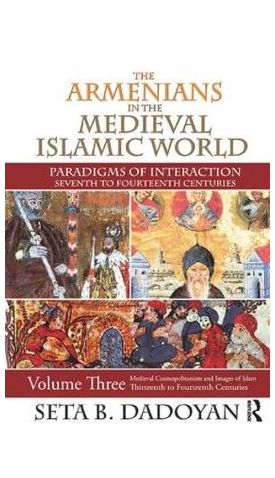

In the third volume of the trilogy, Seta B. Dadoyan focuses on social and cultural aspects, rather than the core political focus exhibited in her first two volumes. Her objective is to suggest political readings of these themes and related texts by revealing hitherto unstudied and novel interactions in the cities of Asia Minor during the Mongol Period.
Dadoyan focuses on the Armenian condition and role in the medieval Islamic world. She argues that if the entire region was the habitat of most of the Armenians, their history too is part of these locations and peoples. Dadoyan draws the outlines of a new philosophy of Armenian history based on hitherto obscured patterns of interaction.
The first three chapters of this volume are dedicated to the images of Prophet Muhammad in Armenian literature. Dadoyan shows that direct interactions and borrowings happened regularly from Islamic sciences, reform projects, poetry, and arts. Dadoyan argues that the cosmopolitan urban environments were radically different from rural areas and close interactions took different and unexpected patterns. In the last part of the volume, she presents the first and only polemical-apologetic Armenian texts addressed to Islam at the end of the fourteenth century. This book is essential for all historians and Middle East scholars and is the latest volume in Transaction's Armenian Studies series.
| עמודים / Pages | 316 |
|---|---|
| פורמט | Paperback / softback |
| ISBN10 | 1138515418 |
| יצא לאור ב | London |
| תאריך יציאה לאור | 28 בספט׳ 2017 |
| תוכן עניינים | Contents of the Previous Two Volumes in This Series Transliteration Tables Prologue General Introduction Introduction to Volume One Introduction to Volume Two Introduction to Volume Three Part One Paradigms of Medieval Cosmopolitanism: The Case of Erznka/Erzinjn Sciences, Society, and Literature in the Thirteenth Century 1 The City of Erznka and the Ism'l Connection I. Erzinjn/Erznka and Three Levels of Interaction II. The City of Erznka and the Ism'l Channel III. Ism'ls, Qarmt.ians, and the Ras'il Ikhwn al-S.af' or Epistles of the Brethren of Purity IV. The Ras'il: Sources, Objectives, and Content V. The Doctrine of Brotherhood and Organizational Matters 2 Secularization of Knowledge and Sciences: An Armenian Summary of Ras'il Ikhwn al-S.af' I. Yovhanns Erznkac'i and Ras'il Ikhwn al-S.af' as Model for His I Takac' Imastasirac' Groc' K'aeal Bank' (Views from the Writings of Islamic Philosophers) II. Comparative Study of the Views and the Ras'il A. Classification of the Sciences B. Epistemology and Logic C. Man's Knowledge of Himself in Accordance with His Nature D. Physical Sciences and Metaphysics E. The Principle of Causality and Theory of Emanation F. Cosmology, Astronomy, Astrology The Analogy between the World and Man III. The Philosophical Writings of Yovhanns Erznkac'i in Light of the Ras'il A. Philosophy and Classification of the Sciences B. Concept of Man: Constitution and Status The Soul and the Body C. Man as Soul D. The Body and the Relationship to the Soul E. Theory of Knowledge F. Theory of Morals G. Social-Political Philosophy H. Cosmology and Astronomy 3 Project for the Spiritualization and Control of Urban Society:'Abbsid Caliph al-Ns.ir's Futuwwa Project as Model for the Constitution of the Brotherhood of Erznka I. Caliph al-Ns.ir's Futuwwa Project and the Constitution of the Brotherhood of Erznka II. The Fat, Manuk, Jawanmard, Aqq/Akh, and Urban Motifs of Manliness A. The Ah.dth and Fityn in the Near Eastern Cities B. The Armenian Manuks and Manktawags III. Caliph al-Ns.ir's Futuwwa Reform: Ideology, Strategy, and Diffusion in Asia Minor A. Al-Ns.ir's Decree IV. The Ns.ir Futuwwa and Akhism in Seljuk Asia Minor V. The Ns.ir Model and the Constitution for the Brotherhood of Erznka VI. The Constitution Part One: "Definitions and Canons" (Sahman ew Kanonk') and Kitb al-Futuwwa VII. Additional Canons (Krkin Kanonk') Addressed to Manuks and Manktawags VIII. The Nir Program and Constitutions in the East European Armenian Communities Fourteenth Nineteenth Centuries 4 Urbanization of Culture The Cultural Significance of the Fityn and Manuks I. The Contrast: The Reform Projects and the Realities of Urban Society and Its Culture II. The Medieval Urban Artworld III. The Urban Coalitions and the Sects: Marginal Communities and Perspectives IV. Kostandin Erznkac'i: Two Worlds and Two Natures in Man A. The Concept of Love and Christ: Synthesis of Kostandin and the Controversy V. Yovhanns and Yakob Manktawag: A Dantean Dialogue VI. The Later Kostandin Part Two The Prophet and Islam in Armenian Literature Seventh to Fourteenth Centuries: Armenian Conceptualization of Islam through Polemics Apologetics 1 Life and Teachings of Prophet Muh.ammad I. Early Life of the Prophet The Migration (al-Hijrah) and the Mednan Period A. The Migration or al-Hijrah Muh.ammad at Mednah II. The Constitution of Mednah III. The Last Years at Mednah 627/5H 632/11H IV. The Message of Islam V. Formation of the Early Islamic Community or the Ummah 2 Islam and the Tradition of Arab-Christian Apologetic/Polemical Literature I. Islam and Muslim Apologetic/Polemical Literature II. Christian Apologetic/Polemical Traditions East and West Seventh Fourteenth Centuries A. Circumstances and Contexts B. Christian Apologists/Polemicists: Yuh.ann or John of Damascus (d. before 754) C. Theodore Ab Qurrah (d. 820), Nonnus of Nisibis The Genre of Letters and Epistles III. Western-Crusader Perspectives Eleventh Thirteenth Centuries 3 The Armenian Mahmet/Muh.ammad I. The Cycle of Mahmet Legends II. The Armenian Mahmet and His Teachings III. Some "Problematiques" of the Armenian Mahmet 4 Grigor and Matt'os: Texts and Polemical Strategies I. Three Polemical Texts in 1390s by Grigor Tat'ewac'i and Matt'os uayec'i II. The Role of Late Medieval Monastic Schools in Eastern Armenia III. Mongol Times in Siwnik' and Polemical Strategies IV. Grigor, Matt'os and Their Work A. Heresy in the Triangle of Reason, Social Norms, and Religion The Ner. or Antichrist B. Matt'os uayec'i Life and Work V. The Texts and Polemical Strategies A. Various Responses to the Questions of the Infidels by Matt'os The "Seven Questions" B. Grigor, nddm Tajkac'(Against the Tajiks) and the Sixteen Fallacies or "Molorut'iwns" Summary: The Arguments in Volume One Summary: The Arguments in Volume Two Summary: The Arguments in Volume Three Bibliography Index |
Login and Registration Form