אנו משתמשים ב-Cookies כדי לשפר את החוויה שלך. כדי לקיים ההנחיה החדשה של e-Privacy, עלינו לבקש את הסכמתך להגדיר את ה-Cookies. קבלת מידע נוסף.

262.00 ₪
The Armenians in the Medieval Islamic World: Armenian Realpolitik in the Islamic World and Diverging
262.00 ₪
ISBN13
9781138515406
יצא לאור ב
London
זמן אספקה
21 ימי עסקים - לא במלאי בארץ
עמודים / Pages
347
פורמט
Paperback / softback
תאריך יציאה לאור
28 בספט׳ 2017
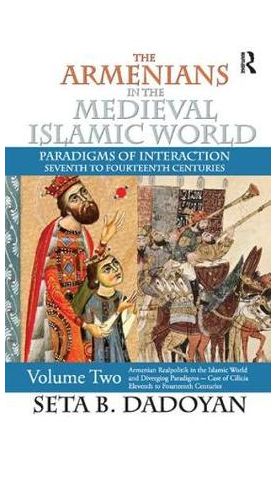

In the second of a three-volume work, Seta B. Dadoyan explores the Armenian condition from the 970s to the end of the fourteenth century. This period marked the gradual loss of semi-autonomy on the traditional mainland and the rise of Armenian power of diverging patterns in southeastern Asia Minor, north Syria, Cilicia, and Egypt.
Dadoyan's premise is that if Armenians and Armenia have always been located in the Middle East and the Islamic world, then their history is also a natural part of that region and its peoples. She observes that the Armenian experience has been too complicated to be defined by simplistic constructs centered on the idea of a heroic, yet victimized nation. She notes that a certain politics of historical writing, supported by a culture of authority, has focused sharply on episodes and, in particular, on the genocide.
For her sources, Dadoyan has used all available and relevant (primary and secondary) Armenian sources, as well as primary Arab texts and sources. This book will stimulate re-evaluation of the period, and re-conceptualizing Armenian and Middle Eastern histories.
| עמודים / Pages | 347 |
|---|---|
| פורמט | Paperback / softback |
| ISBN10 | 113851540X |
| יצא לאור ב | London |
| תאריך יציאה לאור | 28 בספט׳ 2017 |
| תוכן עניינים | Contents of Other Volumes in This Series Transliteration Tables Prologue Introduction 1 Bilad al-Sham in the Eleventh and Twelfth Centuries and the Armenian Intermezzo I. The Armenian Intermezzo: Argument for the Classification of the Period as a Unique Phase II. Emigrations and Settlements in al-Sham in the Ninth and Tenth Centuries III. Greeks, Christians, Armenians, Isma'ilis, Hamdanids, Fatimids, Kalbis, and Kilabis in al-Sham during the Ninth and Tenth Centuries IV. Th e Ghuzz/Turkmens and Seljuks in Asia Minor, Armenia, and al-Sham A. Early Turkish Penetration and the Armenians B. Al-Sham in the Eleventh and Twelfth Centuries C. Th e Ghuzz in Syria 2 Armenian Byzantine and Armenian-Islamic Realpolitik and Peripheral Principalities I. Armenian Byzantine Realpolitik and Peripheral Principalities, Eleventh to Twelfth Centuries II. The T'ondrakian Isma'ili Connection Gorg, Lazar, and T'oros as Missing Link "Brigands" and the Rise of a Heterodox Ruling Class on the Frontiers III. Armenian Muslim Realpolitik: Muslim Armenian Powers A. The Turkish and Turkmen Attires 1. The Nawiki/Bawiqi/Yaruqi/Awaqis: Amir Ktric, Ibn Khan, and Aqsiz/Atsiz 2. Th e Danishmandids in Cappadocia 1055/ 447H 1173/569H B. Political Converts among Territorial Principalities 1. The "State" of Philaretus 2. Bene (or Banu) Boghusaks in Siberek/ Sewawerak 1040 1200 3. The Armenian Nusayri Ruzzaiks/Ruzziks in Syria 3 The Fatimid Armenians Translations of Islam into Power I. The Armenians in Egypt II. The Involvement of the Pro-Byzantine Armenian Institutions in Egypt A. Catholicos Grigor II Vkayaser (or Martyrophil) Pahlawuni B. Vizier Bahram al-Armani and Caliph al-Hafiz an Aborted "Crusade" III. Muslim Armenian Vizierial Rule, 1074 1163 A. A Hypothesis about the Beginnings of Badr in Aleppo: Al-Amir'Aziz al-Dawlah B. The Jamali House of Fatimid Viziers 1. Armenian Turkish Rivalry and the Vizierate of Badr al-Jamali 2. Abu'l-Qasim al-Afdal Shahanshah Ibn Badr al-Jamali 3. Abu'Ali Ahmad Kutayfat al-Akmal Ibn al-Afdal (1131) C. Abu'l-Fath Yanis al-Rumi al-Armani (1132) D. The Nusayri Banu Ruzziks and the End of Armenian Vizierial Rule 1. Abu'l-Gharat Faris al-Muslimin Tala'i' Ibn Ruzzik (1154/549H 1161/556H) 2. Abu Shuja' Badr ed-Din, al-Nasir Muhyy ed-Din Majd al-Islam Ruzzik Ibn Tala'i' (1161 1162) 3. Other Figures Two Karakushs IV. The Testimony of Architecture A.Th e Frescos of the White Monastery Links between the Armenian North and the South B. Armenian Forms in Fa?imid Egypt C. Badr's Juyushi Mosque/Mashhad on Muqattam Hill 1085: Memorial to Power and Tragedy D. The "Thousand and One Nights" of al-Afdal 4 The "Dynastic Triangle" or the Second Age of Kingdoms Diverging Paradigms and the Case of Armenian Cilicia: Twelfth to Fourteenth Centuries I. The Dynastic Triangle or the Second Age of Kingdoms II. The Mongols: Penetration and Politics A. The Twelfth Century: Conversions and Social Change in Asia Minor and North Syria B. The Zak'arids (or Zak'arians) C. Mongol Invasions and a New Phase in Asia Minor D. The Hypothesis of "Mongol Imperial Ideology" III. Cilicia Paradigm Case between the East and the West A. Four Points as an Introduction to the Cilician Case B. Factors in the Making of Armenian Cilicia C. The Cilician Principality between the Turks and the Franks D. Prince Mleh and His Zanki Alliance: A Counter- Paradigm and the Nawiki/ Yaruqi Connection E. Cilicia and the Ayyubids F. The Fall of Jerusalem and the Famous "Oath of Salad ed-Din to the Armenians and Christians" G. The Aftermath: Franks and Armenians H. The Project of the Latin Armenian Kingdom IV. The Kingdom and the Church between Latins, Byzantines, Ayyubids, Mongols, and Mamluks A. Ecumenism and Politics B. King Lewon I: Realpolitik, the Cilician Spirit, and the Kingdom C. The Latin Armenian Kingdom of Cilicia between Franks and Muslims D. Cilicians, Mongols, and Mamluks Het'um I and Mongol Khans 181 E. The Conquests of Baybars (1261 1271) F. Church Union Councils and Popular Dissent the Fall of the Kingdom 5 The Cilician Spiritual and Intellectual Legacy between the East and the West 197 I. Beginnings in the Eleventh Century in the North: Narekac'i, Magistros, and Imastaser A. Grigor Narekac'i: Major Paradigm in Armenian Dissident Thought B. Grigor Pahlawuni Magistros and Secularization of Knowledge C. Yovhannes Sarkawag-Imastaser Forerunner of the Second Phase of Armenian Philosophy II. The Silver Age in a New World: Th eology, Philosophy, and Arts A. Cilician Translations and the Armenian Version of the Chronicle of Michael the Syrian B. Vkayaser/Martyrophil, Grigor III, snorhali, Grigor IV Tlay, and Nerses Lambronac'i III. Church Union and the Predicament of the Cilicians the Literature IV. The Theological Philosophical Legacy of the Twelfth Century V. New Thinkers: Society, Philosophy, and Science Aygekc'i, Rabuni, and Herac'i VI. New Science VII. New Philosophy: Armenian "Nominalism" Rabuni in Cilicia and Orotnec'i in the East VIII. Cilician Aesthetics and New Arts: Poetry and Painting A. Poetry and Narekac'i as a Major Influence; New Visions of God, Man, and Nature; sarakans B. The Cilician Art of Miniatures: Roslyn and Picak as "Nominalists" Summary: The Arguments in Volume Two Bibliography Appendix Index |
Login and Registration Form